
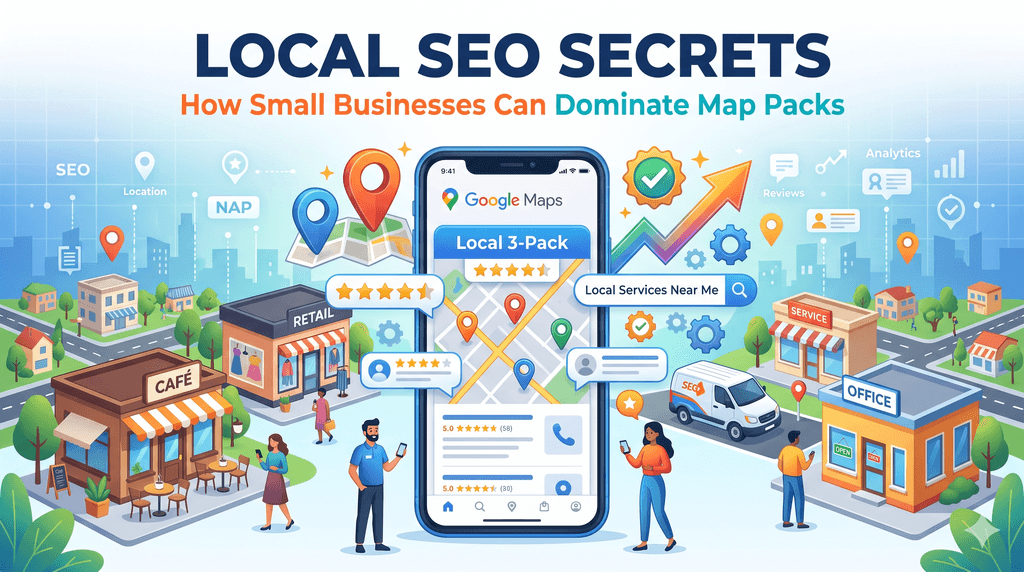
Local SEO – When potential customers search for services near them—whether it’s a café, a digital marketing agency, or a local repair service—they rarely scroll past the top of the search results page. The Google Local 3-Pack (the trio of map listings displayed above standard organic results) captures the vast majority of local search intent and high-converting leads.
If your business isn’t appearing in those top three map spots, you are effectively giving away high-intent leads to your direct competitors. Here is a comprehensive, actionable framework to optimize your local online footprint, dominate map packs, and turn local searches into paying customers.
1. Complete and Verify Your Google Business Profile (Local SEO)
Your Google Business Profile is the primary anchor of local search engine optimization. An unverified or partially filled profile signals a lack of reliability to Google’s ranking algorithms.
- NAP Consistency: Ensure your Name, Address, and Phone number match word-for-word across your website, social profiles, and external local directories it helps in your local SEO rankings.
- Primary Category Selection: Choose the primary category that most specifically reflects your core business, not just a broad general term.
- Secondary Categories: Add up to 9 relevant sub-categories to cover secondary offerings without diluting your primary focus.
- Business Hours & Holiday Schedules: Keep standard and holiday business hours strictly updated to maintain profile trust scores.
2. Engineer Keyword-Rich Business Descriptions and Services
[Primary Service] + [City/Locality] + [Unique Value Proposition][Primary Service] + [City/Locality] + [Unique Value Proposition]
Strategic Placement Guidelines
- Business Description: Write a clear, engaging 750-character overview incorporating your primary service keywords and service areas naturally within the first 250 characters.
- Services & Products Menu: Explicitly list individual services, detailed descriptions, and transparent pricing where applicable. Avoid generic service names; use term variants local customers actively type into search bars which improvesour Local SEO.
3. Build a Review Velocity and Response Strategy
Review quantity alone is no longer sufficient. Search engines prioritize review recency, review sentiment, and response engagement.
Review Impact = (Quantity × Recency) + Keyword-Rich Customer Text + Owner Response Rate
Systematize Requests: Send automated SMS or email review requests immediately following successful service delivery or purchase completion.
Prompt Specific Keywords: Ask satisfied clients to mention the specific service performed and their specific neighborhood or locality in their review text.
Maintain 100% Response Rate: Respond to all reviews—positive and negative—within 24 to 48 hours. Incorporate relevant service and local terms naturally into your responses.
4. Optimize On-Page Local Signals on Your Website
Your local map rankings are directly tied to the authority and technical structure of your primary landing pages.
| On-Page Element | Best Practice Strategy |
| Title Tags & Meta Descriptions | Place [Primary Keyword] - [Neighborhood/City] near the beginning of HTML head tags. |
| Header Tags (H1, H2) | Structure content with localized headers (e.g., ## Digital Marketing Courses in Jayanagar). |
| Local Schema Markup | Embed LocalBusiness JSON-LD structured data with precise geo-coordinates, address, and phone details. |
| Embedded Google Map | Embed your custom Google Maps iframe directly on your contact page or localized landing pages. |
5. Build High-Authority Local Citations and Geotagged Visuals
External validation signals reinforce your geographical relevance to search engine algorithms.
- Tier-1 Local Directories: Secure verified listings on authoritative platforms such as Bing Places, Apple Maps, Yelp, and industry-specific local directories.
- Niche Local Citations: Obtain listings on local commercial clubs, community networks, and regional business portals.
- Geotagged Visual Media: Upload fresh high-resolution photos of your workspace, team, and projects regularly to your Google Business Profile to demonstrate active operational status.
Summary -Action Plan
- Audit and align your NAP consistency across all web properties.
- Complete all sections of your Google Business Profile, including custom services and localized descriptions.
- Deploy an automated customer review solicitation and response framework.
- Add LocalBusiness JSON-LD Schema to your website’s home and contact pages.
- Publish localized visuals and update profile posts weekly to maintain maximum search visibility.