
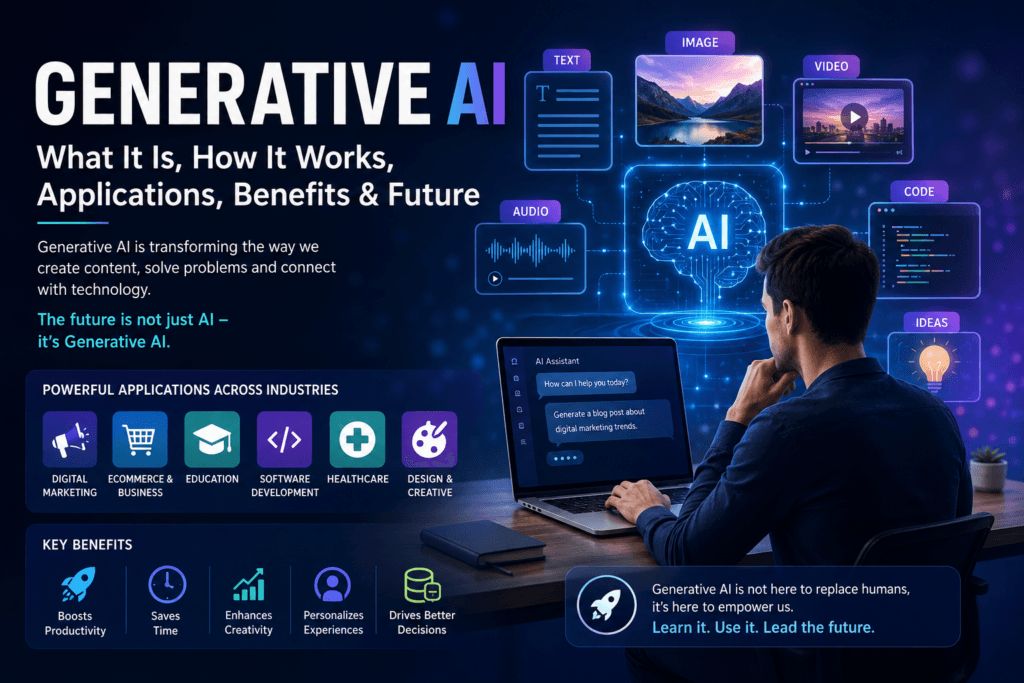
Artificial intelligence has been part of our digital world for years, but Generative AI has changed the way people interact with technology.
From writing an email and creating an image to generating a video, analyzing information, writing computer code, and brainstorming marketing ideas, Generative AI can create new content based on a simple human instruction.
But Generative AI is much more than a collection of AI tools.
It represents a major shift in how we work with technology. Instead of simply asking a computer to perform a predefined task, we can now describe what we want in natural language and collaborate with an AI system to produce it.
For students, professionals, entrepreneurs, content creators, and digital marketers, understanding Generative AI is becoming increasingly important.
In this guide, we will explore what Generative AI is, how it works, its applications, benefits, limitations, popular tools, and how it is changing the future of digital marketing and business.
What Is Generative AI?
text, images, videos, audio, presentations, software code, and other forms of digital content based on instructions provided by a user.
Traditional AI is often designed to analyze information, identify patterns, make predictions, or classify data.
Generative AI goes a step further.
It learns patterns from large amounts of training data and uses those learned patterns to generate new outputs.
For example, you could ask a Generative AI system:
“Write a 500-word blog introduction about sustainable fashion.”
Instead of simply searching the internet for an existing paragraph, the system can generate a new response based on your instruction.
Similarly, you can provide an image prompt such as:
“Create a realistic image of a peaceful forest with a river flowing through it at sunrise.”
An image-generation model can then create a new image based on that description.
This ability to generate content is what makes Generative AI different from many traditional AI applications.
How Does Generative AI Work?
Generative AI may look simple from the user’s perspective, but there is a complex process happening behind the scenes.
At a high level, Generative AI systems work through several important stages.
1. Training With Large Amounts of Data
AI models are trained using very large datasets.
Depending on the type of model, the training data may include:
- Text
- Images
- Audio
- Video
- Software code
- Other digital information
During training, the model learns patterns, relationships, structures, and probabilities within the data.
For example, a language model learns how words and concepts are related and how language is structured.
2. Understanding the User’s Prompt
When you provide an instruction, the AI system processes the words and context in your prompt.
For example:
“Write five Instagram captions for a bakery launching a new chocolate cake.”
The AI interprets the subject, purpose, audience, format, and other information contained in the instruction.
3. Generating an Output
The model then predicts and generates an appropriate response based on what it has learned.
Depending on the AI system, the result might be:
- A paragraph
- An article
- An image
- A video
- A voice recording
- Computer code
- A marketing strategy
- A summary
4. Refining the Result
One of the most useful features of Generative AI is that you can continue the conversation.
You don’t always need to start again.
You can say:
“Make it shorter.”
Then:
“Make it more professional.”
Then:
“Rewrite it for small business owners.”
This makes Generative AI feel less like a traditional software application and more like an interactive assistant.
Generative AI vs Traditional AI
One of the easiest ways to understand generative AI is to compare it with traditional artificial intelligence.
| Traditional AI | Generative AI |
|---|---|
| Often analyzes existing information | Can generate new content |
| Commonly used for prediction and classification | Commonly used for content creation |
| May identify patterns | Learns patterns and generates outputs |
| Frequently works within predefined tasks | Can respond to flexible natural-language instructions |
| Example: fraud detection | Example: generating a marketing campaign |
However, the difference is not always absolute.
Many modern AI systems combine analysis, prediction, retrieval, reasoning, and generation.
The important distinction is that Generative AI has the ability to produce new content rather than simply classify or analyze existing information.
Examples of Generative AI
Generative AI is now being used across many areas of work and everyday life.
Text Generation
AI can help create:
- Blog posts
- Emails
- Social media captions
- Product descriptions
- Reports
- Scripts
- Marketing copy
- Summaries
- Brainstorming ideas
Image Generation
AI image tools can generate visuals from text descriptions.
For example:
“Create a modern Instagram advertisement for a digital marketing course.”
The system can generate an image based on the concept.
Video Generation
Generative AI can assist with:
- Video concepts
- Scripts
- Storyboards
- Animations
- Visual scenes
- Video editing
Audio and Voice Generation
AI can also generate or transform:
- Voiceovers
- Music
- Sound effects
- Audio content
Code Generation
Developers can use Generative AI to:
- Generate code
- Explain programming concepts
- Find bugs
- Write documentation
- Create prototypes
- Convert code between programming languages
Popular Generative AI Tools
The Generative AI ecosystem is expanding rapidly, with different tools designed for different purposes.
Some popular categories include:
AI Chatbots and Language Tools
These can help with writing, research, brainstorming, coding, learning, and content creation.
Examples include:
- ChatGPT
- Google Gemini
- Claude
- Microsoft Copilot
AI Image Generation
Image-generation platforms can create visuals from text prompts and assist with creative design.
AI Video Tools
These tools can help create video content, animations, advertisements, and other visual media.
AI Productivity Tools
Generative AI is also increasingly integrated into:
- Email platforms
- Office applications
- Design software
- Project management tools
- Customer-support systems
- Marketing platforms
The important thing is not simply knowing the names of AI tools.
The real skill is knowing which tool to use, what to ask it, and how to evaluate the result.
Applications of Generative AI
Generative AI is not limited to content creation.
It is being applied across industries and professional roles.
1. Generative AI in Digital Marketing
Digital marketers are among the professionals who can benefit significantly from Generative AI.
AI can assist with:
- Keyword research
- Content ideas
- Blog outlines
- Ad copy
- Social media content
- Email campaigns
- Customer personas
- Marketing research
- Content repurposing
- Landing-page ideas
- Video scripts
For example, a marketer could take one long-form blog article and use AI to develop:
- Instagram captions
- LinkedIn posts
- Email content
- Short video scripts
- Ad variations
This can dramatically reduce repetitive work.
But there is an important distinction.
AI should support the marketer, not replace the marketer’s judgment.
A good marketer still needs to understand the audience, brand positioning, search intent, customer psychology, analytics, and business objectives.
2. Generative AI for Content Creation
Content creators can use Generative AI during different stages of production.
For example:
Idea → Research → Outline → Draft → Editing → Repurposing → Distribution
AI can assist with several of these stages.
However, blindly publishing AI-generated content can result in generic material that lacks personality and originality.
The best results usually come from combining:
Human experience + AI assistance + fact-checking + editing.
3. Generative AI for Businesses
Small businesses can use AI to reduce repetitive work and improve productivity.
For example, a small business owner could use AI to help prepare:
- Customer responses
- Product descriptions
- Promotional ideas
- Meeting summaries
- Business documents
- Social media content
- Frequently asked questions
- Internal communications
This can be especially useful for businesses that do not have large marketing or content teams.
4. Generative AI in Education
Students and teachers can use AI as a learning assistant.
It can help explain difficult concepts, generate practice questions, summarize information, and provide alternative explanations.
For example, instead of asking:
“Give me the answer.”
A student can ask:
“Explain this concept to me like I’m a beginner, then give me three examples and five practice questions.”
That approach turns AI into a learning companion rather than simply an answer generator.
5. Generative AI in Software Development
Software developers are using AI to assist with coding and development workflows.
AI can help developers:
- Generate code snippets
- Explain unfamiliar code
- Identify potential bugs
- Create test cases
- Write documentation
- Explore technical approaches
However, generated code still needs human review.
A developer should understand what the code does before using it in a production environment.
Benefits of Generative AI
Why has Generative AI become so popular?
There are several reasons.
Faster Content Creation
AI can generate a first draft in seconds or minutes.
This doesn’t mean the final result should be published immediately, but it can significantly reduce the time needed to get started.
Improved Productivity
Professionals can delegate repetitive tasks to AI and spend more time on strategy, creativity, and decision-making.
Faster Brainstorming
When you are stuck, AI can provide multiple ideas that you can evaluate and develop further.
Personalization
AI can help businesses create different versions of content for different audiences.
Accessibility
People without advanced technical skills can now interact with powerful technology using natural language.
What Are the Limitations of Generative AI?
Generative AI is powerful, but it is not perfect.
One of the biggest mistakes people make is assuming that everything an AI system generates is automatically correct.
It isn’t.
AI Can Produce Incorrect Information
Generative AI systems can sometimes produce convincing but inaccurate information.
This is why important facts should be verified.
AI Can Lack Context
An AI model may not fully understand your business, customers, brand voice, or personal experiences unless you provide sufficient context.
AI-Generated Content Can Sound Generic
If everyone uses the same prompts and publishes the first response, the internet can quickly become filled with repetitive content.
Privacy Matters
Sensitive business information, confidential documents, customer data, and personal information should be handled carefully when using AI tools.
Human Judgment Is Still Essential
AI can generate possibilities.
Humans still need to decide which possibilities are useful, accurate, ethical, and appropriate.
Will Generative AI Replace Humans?
This is probably one of the most common questions about Generative AI.
The more realistic answer is that Generative AI is likely to change many jobs rather than simply eliminate all human work.
Consider digital marketing.
AI can generate ten advertisement headlines in a few seconds.
But which headline is best?
That requires understanding:
- The target audience
- The product
- The competition
- Customer psychology
- Brand positioning
- Campaign objectives
- Performance data
The same principle applies to many professions.
People who learn how to work effectively with AI may have an advantage over people who completely ignore it.
The future is therefore less about humans versus AI and more about humans working with AI
Generative AI and the Future of Digital Marketing
Digital marketing is already changing because of AI.
Search engines are evolving.
Advertising platforms are becoming increasingly automated.
Content creation is becoming faster.
Customers expect more personalized experiences.
And businesses have access to more data than ever before.
This means digital marketers need a broader skill set.
A modern marketer may need to understand:
- SEO
- Search intent
- Google Ads
- Social media marketing
- Analytics
- Content strategy
- AI tools
- Automation
- Conversion optimization
- Customer psychology
Generative AI can accelerate many of these activities, but strategy remains extremely important.
The marketer who simply asks AI to “write a blog” may produce average content.
The marketer who understands the customer, search intent, content structure, brand voice, and SEO—and then uses AI intelligently—can create much stronger results.
How to Use Generative AI Effectively
If you are new to Generative AI, start with simple tasks.
Step 1: Give Clear Instructions
Instead of:
“Write a blog about SEO.”
Try:
“Write a beginner-friendly 1,500-word article explaining SEO for small business owners. Use practical examples and avoid technical jargon.”
The more useful context you provide, the more useful the output can become.
Step 2: Provide Your Audience
Tell the AI who the content is for.
For example:
“The audience is small business owners with no previous digital marketing experience.”
Step 3: Specify the Desired Format
You can request:
- Blog
- Table
- Checklist
- Social media post
- Video script
- Presentation outline
Step 4: Review the Output
Never assume that AI-generated information is automatically accurate.
Check important facts, statistics, names, dates, and claims.
Step 5: Add Your Human Experience
This is where your content can become genuinely different.
Add:
- Your own examples
- Customer experiences
- Professional opinions
- Case studies
- Lessons learned
- Local examples
- Original insights
This is also one of the best ways to prevent your content from sounding generic.
Is Generative AI Good for SEO?
Generative AI can be extremely useful for SEO, but using AI alone does not guarantee rankings.
Search engines ultimately aim to provide useful results to users.
Instead of focusing on producing hundreds of AI-generated articles, businesses should focus on creating helpful, original, relevant, trustworthy content that satisfies the searcher’s intent.
AI can help with:
- Topic research
- Content outlines
- Keyword clustering
- Content briefs
- FAQ ideas
- Title variations
- Content optimization
- Repurposing existing content
But the final article should be reviewed and improved by a human.
For example, if you are writing about digital marketing, adding your own practical experience from working with campaigns, websites, students, or businesses can make the content far more valuable than a generic AI-generated article.
The Future of Generative AI
Generative AI is still developing rapidly.
Future AI systems are likely to become more capable of understanding different types of information simultaneously, including text, images, audio, video, and other data.
We are also moving toward AI systems that can do more than generate content.
They can increasingly help people:
Plan → Analyze → Create → Automate → Improve
This could transform how businesses operate and how professionals perform everyday tasks.
But the most valuable skill may not be learning every new AI tool.
Tools will change.
Platforms will change.
Features will change.
The fundamental skill that remains valuable is the ability to think critically, communicate clearly, understand problems, and use technology strategically.
Final Thoughts
Generative AI is not simply another technology trend.
It is changing how people create, learn, communicate, market products, develop software, and solve problems.
The biggest opportunity is not to use AI to do everything for us.
It is to use AI to remove repetitive work while giving humans more time to think, create, experiment, and make better decisions.
For students and professionals entering the digital world, learning Generative AI alongside digital marketing, analytics, SEO, advertising, and other practical skills can be a powerful combination.
The future will not necessarily belong to people who know the most AI tools.
It will belong to people who know how to use AI intelligently.
Frequently Asked Questions About Generative AI
What is Generative AI in simple words?
Generative AI is a type of artificial intelligence that can create new content such as text, images, audio, video, and code based on instructions provided by a user.
What are examples of Generative AI?
Examples include AI systems that generate text, images, videos, audio, and computer code. ChatGPT, Google Gemini, Claude, and Microsoft Copilot are examples of AI assistants that can perform various generative tasks.
How is Generative AI different from AI?
Artificial intelligence is a broad field that includes systems designed for prediction, classification, analysis, automation, and generation. Generative AI specifically focuses on creating new content.
Can Generative AI replace digital marketers?
Generative AI can automate and accelerate many digital marketing tasks, but it does not eliminate the need for human strategy, creativity, analysis, customer understanding, and decision-making.
Is Generative AI useful for SEO?
Yes. Generative AI can assist with research, content planning, keyword ideas, outlines, optimization, and content repurposing. However, using AI-generated content alone does not guarantee search rankings. Originality, usefulness, relevance, accuracy, and satisfying search intent remain important.
Is Generative AI difficult to learn?
The basic concepts are relatively easy to understand. The more valuable skill is learning how to use AI effectively for real-world tasks, including writing effective prompts, evaluating outputs, fact-checking information, and integrating AI into professional workflows.
What skills should I learn along with Generative AI?
Depending on your career goals, useful complementary skills in Digitalents Academy as we provide the best digital marketing courses in Bangalore includes digital marketing, SEO, Google Ads, social media marketing, analytics, content creation, automation, data analysis, and critical thinking.
Conclusion
Generative AI is changing the relationship between humans and technology.
We are moving from a world where people had to learn how software works to accomplish a task toward a world where people can increasingly describe the result they want and collaborate with AI to achieve it.
The technology will continue to evolve.
The opportunity is to learn how to use it responsibly, creatively, and strategically.
Don’t just learn how AI works. Learn how to make AI work for you.
What I Have Learned About Generative AI as a Digital Marketing Professional
Then discuss your genuine observations.
For example:
One thing I have noticed while working with digital marketing is that AI is most useful when it is treated as a working partner rather than a shortcut. It can help generate ideas and speed up repetitive tasks, but the quality of the final result depends heavily on the person’s understanding of marketing, customers and the business objective.
This kind of section is valuable because it gives the article a genuine first-hand perspective.
Ready to Learn AI-Powered Digital Marketing?
Generative AI is changing the way marketers work, but knowing how to use AI effectively is only one part of modern digital marketing.
At Digitalents Academy, you can learn practical digital marketing skills including SEO, Google Ads, social media marketing, analytics, AI tools and more.
Learn the skills. Practice with real-world strategies. Build your digital marketing career.