
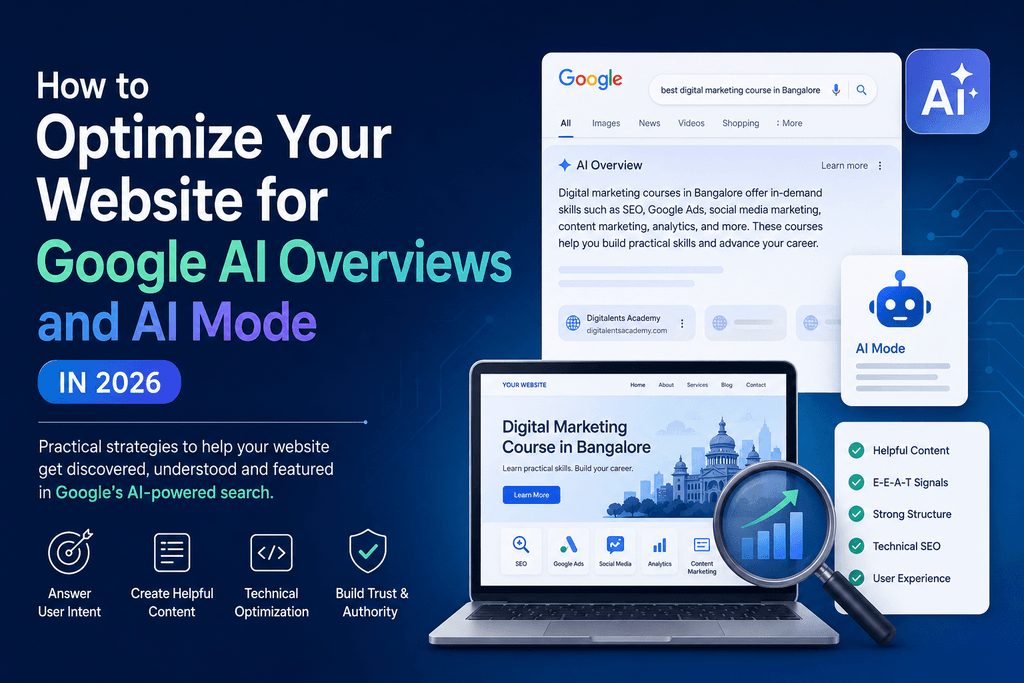
Google AI Overviews ,Google Search is changing. Are you preparing your website for the new way people search?
For years, businesses focused on one primary goal: getting their website to appear on the first page of Google.
The strategy was familiar — research keywords, optimize titles and headings, build backlinks, improve technical SEO, publish useful content, and try to reach the top positions.
But search behaviour is changing.
People are no longer always looking for a list of ten blue links. They are increasingly asking Google complete, conversational questions and expecting Google to understand the context behind those questions.
This is where Google AI Overviews and AI Mode become important.
Instead of simply displaying traditional search results, Google’s AI-powered search experiences can provide synthesized answers and connect users with relevant web sources.
For businesses, this creates a new question:
How do you optimize a website so that Google can understand, trust and potentially surface its content in these AI-powered search experiences?
The answer is not to abandon SEO.
In fact, Google has made it clear that its existing SEO fundamentals continue to matter because AI features in Search rely on Google’s core ranking and quality systems.
The difference is that website owners now need to think beyond rankings and focus on being useful, understandable, trustworthy and genuinely valuable.
What Are Google AI Overviews and AI Mode
Before discussing optimization, it is important to understand what these two experiences actually do.
Google AI Overviews
AI Overviews can provide an AI-generated summary directly within Google Search for certain queries.
Instead of making users open several websites to understand a topic, Google may summarize information from multiple sources and provide links to relevant webpages.
For example, someone searching:
“What digital marketing skills should I learn to get a job in Bangalore?”
may receive an AI-generated overview discussing SEO, Google Ads, social media marketing, analytics, content marketing and AI tools, along with links to relevant sources.
That changes the search journey.
The user may read part of the answer before deciding which website to visit.
Google AI Mode
AI Mode takes the conversational approach even further.
Instead of asking one simple question, users can explore a topic through follow-up questions and more detailed queries.
For example:
could become:
“Which digital marketing skills are most useful for beginners?”
and then:
“Which skills can help me get a job in Bangalore?”
The search experience becomes more conversational and exploratory.
Google has also updated Search Console documentation to account for AI Mode traffic within Search performance reporting.
This means AI-powered search is no longer something website owners can simply ignore.
Does SEO Still Matter for Google AI Overviews
Yes. Absolutely.
One of the biggest misconceptions about AI search is that traditional SEO is becoming irrelevant.
It isn’t.
Google’s current guidance explicitly states that SEO best practices remain relevant for its generative AI search features because those features are built on Google’s core Search ranking and quality systems.
So don’t throw away your:
- Keyword research
- On-page SEO
- Technical SEO
- Internal linking
- Structured data
- Page experience
- Search Console monitoring
- Quality backlinks
- Local SEO
- Helpful content strategy
Instead, think of AI search as an additional layer on top of strong SEO fundamentals.
Your first objective should still be:
Create a website that Google can crawl, understand, index and trust.
Then make that content easier for both users and AI-powered search systems to understand.
1. Create Content That Actually Answers Questions
One of the biggest changes in search behaviour is the growth of conversational queries.
People don’t always search using short keywords anymore.
Instead of:
“digital marketing course Bangalore”
someone might search:
“What should I learn before joining a digital marketing course in Bangalore?”
Or:
“Which digital marketing skills are most useful for getting a job in Bangalore in 2026?”
These are much more detailed questions.
Your content should reflect this behavior.
Instead of writing an article simply because it contains a high-volume keyword, identify the questions your audience genuinely wants answered.
For example, a digital marketing institute could create content around the following:
- What is digital marketing?
- How long does it take to learn digital marketing?
- Is digital marketing a good career in 2026?
- Which digital marketing skills are most in demand?
- What tools should a beginner learn?
- How much does a digital marketing course cost?
- Can beginners get jobs after learning digital marketing?
- What is the difference between SEO and Google Ads?
The goal isn’t to stuff every question into one article.
The goal is to build a useful collection of content that answers real search intent.
2. Put the Answer Near the Top
Don’t make readers scroll through 2,000 words before they discover the answer.
If someone asks:
“What is Google AI Mode?”
give them a short, direct explanation first.
Then expand.
A good structure could look like this:
What is Google AI Mode?
Google AI Mode is an AI-powered search experience that allows users to explore questions conversationally and receive synthesized responses with relevant web sources.
Then continue with:
- How it works
- Why it matters
- Examples
- Optimization strategies
- Common mistakes
This structure is useful for humans because readers can quickly find what they need.
It also creates clearly organized information that search systems can interpret more easily.
3. Stop Writing Generic Content
This may be one of the most important recommendations in this entire article.
There is already an enormous amount of generic content on the internet.
For example:
“Digital marketing is the promotion of products and services using digital channels.”
There is nothing particularly valuable or distinctive about that sentence.
Thousands of websites can say essentially the same thing.
So ask yourself:
What can my article provide that another website cannot easily copy?
That could be:
- Your own experience
- Original research
- Case studies
- Screenshots
- Campaign examples
- Real-world observations
- Data
- Experiments
- Industry examples
- Expert opinions
- Local insights
- Step-by-step processes
Google’s current AI optimization guidance specifically highlights the importance of unique, non-commodity content.
This is particularly important in an era where anyone can generate a 2,000-word article in seconds.
The advantage is no longer simply producing more content.
The advantage is producing better content.
4. Demonstrate First-Hand Experience
This is where human expertise becomes extremely important.
Imagine two articles about Google Ads.
Article A
An AI-generated article explains:
“Google Ads is an online advertising platform that allows businesses to advertise on Google.”
Article B
A digital marketing professional writes:
“When running a Search campaign for a local training institute, one of the biggest problems we encountered wasn’t generating leads — it was generating relevant leads. Broad targeting and weak negative keyword management resulted in enquiries that had little commercial value.”
Which article feels more useful?
The second one.
Why?
Because it contains experience.
You can bring this approach into your Digitalents Academy content.
Instead of simply explaining SEO, Google Ads or AI marketing, discuss what you have actually observed while working with:
- Students
- Businesses
- Campaigns
- Websites
- Search Console
- Google Ads
- Meta Ads
- SEO projects
Real experience gives your content a voice.
5. Build Topic Depth Instead of Writing Isolated Articles
One blog post is rarely enough to establish strong topical coverage.
Suppose you want Digitalents Academy to become known for AI-powered digital marketing.
You could create a content cluster such as:
AI Search
- How Google AI Overviews Work
- How to Optimize for Google AI Overviews
- How Google AI Mode Is Changing Search
- How AI Search Is Changing SEO
- How Businesses Can Improve AI Visibility
SEO
- Technical SEO Guide
- On-Page SEO Checklist
- Local SEO Guide
- Keyword Research
- Internal Linking
- Schema Markup
AI Marketing
- AI Tools for Digital Marketers
- ChatGPT for SEO
- Gemini for Digital Marketing
- AI Content Strategy
- AI for Google Ads
- AI for Social Media Marketing
Then connect these articles with relevant internal links.
This helps users move naturally from one topic to another and gives your website stronger topical depth.
6. Use Clear Heading Structures
Your content should be easy to scan.
Don’t create a giant wall of text.
Use:
H1: How to Optimize Your Website for Google AI Overviews and AI Mode in 2026
H2: What Are Google AI Overviews and AI Mode?
H2: Does SEO Still Matter?
H2: How to Optimize Your Website
H3: Create Question-Based Content
H3: Improve Content Structure
H3: Demonstrate First-Hand Experience
This creates a logical hierarchy.
It also helps readers understand the article before they read every paragraph.
7. Strengthen Your Internal Linking
Internal linking is often underestimated.
Suppose you’re writing an article about Google AI search.
You could naturally link to relevant pages on your website about:
- SEO
- AEO
- GEO
- Google Search Console
- Schema markup
- Keyword research
- Content optimization
- Local SEO
- Digital marketing courses
Don’t add links just for the sake of adding links.
Ask:
“Would this link help the reader understand the subject better?”
If the answer is yes, add it.
Good internal linking creates a connected knowledge structure across your website.
8. Make Your Website Easy for Google to Crawl and Understand
Great content won’t help much if your website has serious technical problems.
Review your:
Technical SEO checklist
- HTTPS
- Mobile usability
- Page speed
- Crawlability
- Indexability
- XML sitemap
- Robots.txt
- Canonical URLs
- Internal links
- Broken links
- Redirects
- Duplicate pages
- Structured data
Also make sure important content isn’t unnecessarily hidden behind technical barriers.
Your objective is simple:
Make it easy for search engines to discover, understand and access your important pages.
9. Use Structured
Data Where It Makes Sense
Structured data helps communicate information about a webpage in a machine-readable format.
Depending on your page, this may include relevant Schema.org types.
For example:
- Article
- Organization
- LocalBusiness
- Course
- BreadcrumbList
- Product
- Event
But don’t add schema simply because someone told you that “more schema means higher rankings.”
Structured data needs to accurately represent the visible content of the page and follow Google’s guidelines.
Also, don’t rely on outdated tactics.
Google has retired several structured-data features over time, including the FAQ rich result feature, so it is important to follow current documentation rather than old SEO tutorials.
10. Optimize Your Local Presence
If your business serves a specific geographic area, local relevance matters.
For example, Digitalents Academy serves students in Bangalore.
Your website should clearly communicate:
- Business name
- Location
- Contact details
- Courses
- Areas served
- Trainers
- Student experiences
- Business information
- Relevant local content
Don’t create dozens of artificial city pages with nearly identical content.
Instead, create genuinely useful local resources.
For example:
“Digital Marketing Career Opportunities in Bangalore in 2026”
could include:
- Skills employers are looking for
- Common job roles
- Tools students should learn
- Career paths
- Interview preparation
- Practical project experience
That’s much more valuable than simply repeating twenty times:
“Best digital marketing course in Bangalore”
11. Make Your Authors and Expertise Visible
A website shouldn’t feel anonymous.
Tell readers:
Who wrote this?
Why should they trust this person?
What experience do they have?
For educational and professional content, author information can help establish context and credibility.
Consider including:
- Author name
- Professional background
- Area of expertise
- LinkedIn profile
- Relevant experience
- Updated date
- Reviewer information where appropriate
Your website should feel like it is written by real people with real knowledge, not a content factory.
12. Use Original Examples
One of the easiest ways to humanize an article is to stop speaking only in theory.
Instead of saying:
“Businesses should optimize their websites for local SEO.”
Show what that means.
For example:
Imagine a digital marketing institute in Jayanagar targeting students from Bangalore. Instead of creating a generic page titled “Digital Marketing Course,” the institute could create useful content answering questions about digital marketing careers, course duration, practical skills, tools, certifications and local career opportunities.
Now the concept becomes practical.
Readers can visualize how to apply it.
13. Don’t Create Hundreds of AI Articles Just for Rankings
AI makes content creation faster.
But faster doesn’t automatically mean better.
One of the biggest mistakes businesses can make in 2026 is generating hundreds of similar articles simply because they want to target more keywords.
Google’s spam policies specifically address scaled content abuse, including large amounts of unoriginal content created primarily to manipulate search rankings.
Use AI as an assistant.
Don’t let it become your entire editorial strategy.
You can use AI to:
- Research ideas
- Generate outlines
- Find questions
- Improve readability
- Identify gaps
- Brainstorm examples
- Review content
But add your own:
- Experience
- Opinions
- Data
- Examples
- Screenshots
- Case studies
- Insights
That’s where the human value comes from.
14. Think in Terms of Entities and Context
Search engines are getting better at understanding relationships between concepts.
For example:
Digital Marketing
connects to:
SEO → Google Ads → Social Media → Analytics → Content Marketing → AI → Email Marketing → Conversion Optimization.
Your website should demonstrate these relationships naturally.
If you have a page about digital marketing courses, connect it with supporting resources about the individual skills you teach.
This creates a more complete picture of your expertise.
15. Keep Your Content Updated
Google AI Overview search is changing quickly.
An article written in 2024 about Google Search may already contain outdated information.
Review important content periodically.
Check:
- Screenshots
- Statistics
- Google features
- Search terminology
- Tools
- Best practices
- Links
- Examples
- Dates
If something has changed, update it.
Don’t simply change:
“Updated: January 2026”
to:
“Updated: September 2026”
without actually improving the content.
An updated date should represent a real content update.
16. Track What Happens After Publishing
Don’t publish the article and forget about it.
Use Google Search Console to monitor:
- Impressions
- Clicks
- CTR
- Search queries
- Pages receiving traffic
- Search performance
- Changes over time
Google’s documentation now includes AI Mode within Search Console’s overall Search performance reporting.
This gives you an opportunity to understand how your content performs as search evolves.
You can then improve articles based on actual search behaviour.
A Practical Google AI Overview Search Optimization Checklist
Before publishing an article, ask yourself:
Content
☐ Does this article answer a genuine question?
☐ Is the information accurate?
☐ Does it provide something beyond generic information?
☐ Have I included real examples?
☐ Have I added first-hand experience where possible?
☐ Does the article demonstrate expertise?
SEO
☐ Is the title clear?
☐ Is the primary search intent satisfied?
☐ Are headings logically structured?
☐ Are internal links relevant?
☐ Is the URL clean?
☐ Is the page indexable?
☐ Are canonical settings correct?
AI Search
☐ Can the main answer be understood quickly?
☐ Are important questions answered clearly?
☐ Is the content organized logically?
☐ Does the page provide original information?
☐ Are claims supported where necessary?
☐ Does the content demonstrate genuine expertise?
User Experience
☐ Is the page easy to read?
☐ Is it mobile-friendly?
☐ Are paragraphs easy to scan?
☐ Are images useful?
☐ Are intrusive elements minimized?
☐ Does the page help the reader accomplish something?
The Biggest Shift in SEO
The biggest change isn’t that Google has introduced AI.
The bigger change is how people interact with search.
Search is becoming more conversational.
Users can ask longer questions.
They can ask follow-up questions.
They can compare options.
They can explore a topic rather than simply search for a webpage.
That means businesses need to think beyond:
“What keyword should I rank for?”
and start thinking:
“What question is my audience trying to solve, and can my website provide one of the best answers available?”
That’s a much stronger content strategy.
Final Thoughts
Optimizing for Google AI Overviews and AI Mode isn’t about finding a secret trick, adding a special meta tag or discovering a magic AI-search ranking factor.
There isn’t a shortcut.
The fundamentals remain surprisingly familiar:
Create useful content.
Make it easy to understand.
Make your website technically accessible.
Demonstrate expertise.
Provide original insights.
Build topical depth.
Earn trust.
Keep improving.
The difference is that search is becoming more intelligent about understanding content and user intent.
So your website needs to become more useful, not simply more optimized.
And that’s perhaps the most important lesson for digital marketers in 2026:
Don’t create content just because you want to rank. Create content that deserves to be found.
When your website consistently answers real questions with useful, original and experience-driven information, you are not only preparing for traditional Google Search—you are building a stronger foundation for the evolving world of AI-powered search.
Frequently Asked Questions
1. What are Google AI Overviews?
Google AI Overviews are AI-generated summaries that can appear within Google Search for certain queries, providing users with a synthesized answer and links to relevant web sources.
2. What is Google AI Overview Mode?
Google AI Mode is a conversational search experience that allows users to explore questions in greater depth and continue with follow-up queries.
3. Does SEO still matter for Google AI overviews?
Yes. Google states that SEO best practices remain relevant because its generative AI search features rely on Google’s core Search ranking and quality systems.
4. How can I optimize my website for AI search?
Focus on strong SEO fundamentals, clear answers, original content, first-hand experience, logical content structure, technical accessibility, internal linking and trustworthy information.
5. Does AI-generated content rank on Google?
AI-generated content isn’t automatically disqualified simply because AI was used. However, Google emphasizes helpful, original content and its spam policies prohibit scaled content created primarily to manipulate rankings.
6. Do I need a special AI SEO plugin?
No special plugin guarantees visibility in AI Overviews or AI Mode. Strong technical SEO, useful content and a clear website structure remain the foundation.
7. Should I create an llms.txt file for Google AI search?
Don’t treat llms.txt as a required Google Search optimization technique. Google clarified in its documentation updates that llms.txt isn’t needed for Google Search and does not provide a positive or negative ranking effect.
Digitalents Academy helps students and professionals develop practical digital marketing skills, including SEO, Google Ads, social media marketing, analytics, AI-powered marketing, and emerging areas of AI search.
If you’re looking to build practical digital marketing skills for today’s changing search landscape, learning how traditional SEO connects with AI-powered search is becoming increasingly important.