
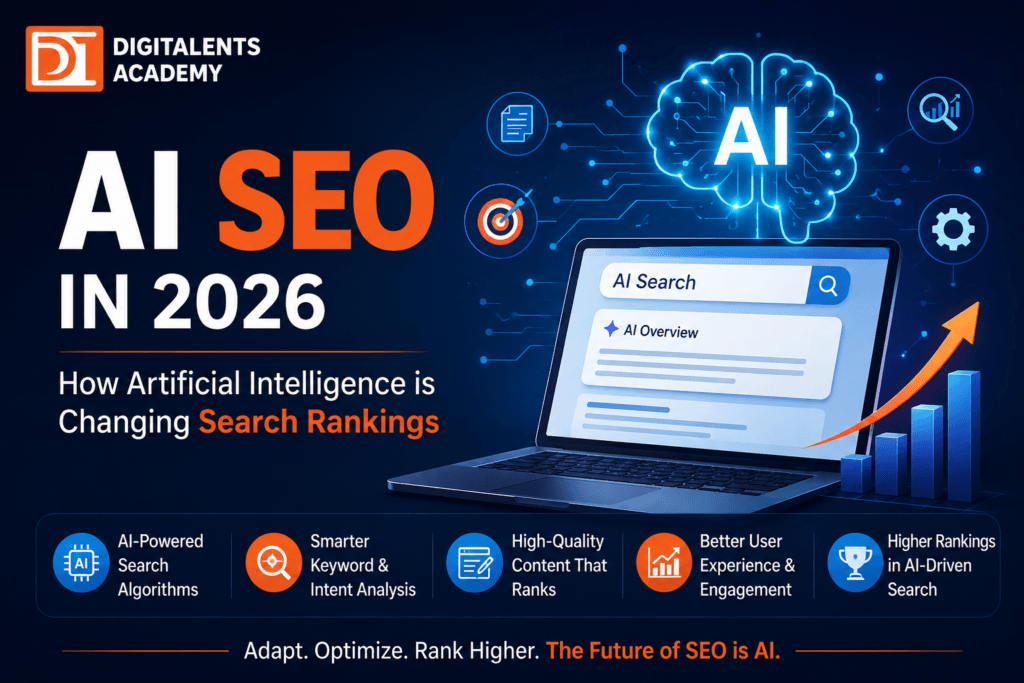
Search Engine Optimization (SEO) has undergone a massive transformation over the last decade. AI SEO in 2026 is no longer just a tool for marketers—it is at the heart of how search engines understand, rank, and deliver information.
With Google’s AI Overviews, AI-powered search experiences, conversational search, and the rise of platforms like ChatGPT, Perplexity AI, and Gemini, businesses must rethink their SEO strategies to remain visible online.
At Digitalents Academy, as we are one of the best digital marketing institute in bangalore, you’ll learn how AI is changing SEO, the latest ranking factors, and practical strategies to improve your website’s visibility in 2026.
What is AI SEO in 2026?
AI SEO in 2026 is the practice of using Artificial Intelligence to improve a website’s visibility in search engines while also optimizing content for AI-driven search experiences.
Unlike traditional SEO, which focused primarily on keywords and backlinks, AI SEO emphasizes the following:
- User intent
- Contextual understanding
- Content quality
- Semantic relationships
- Topical authority
- Structured data
- User experience
AI-powered search engines now understand natural language much like humans, making it essential to create content that genuinely answers users’ questions.
Why AI is Changing Search Rankings
Modern search engines rely heavily on machine learning and natural language processing to evaluate content.
Instead of simply matching keywords, AI evaluates:
- Whether the content solves the user’s problem
- The expertise of the author
- The trustworthiness of the website
- The freshness of information
- User engagement signals
- Website experience
This shift means businesses must prioritize helpful, well-structured, and authoritative content.
Major AI SEO in 2026: Transforming Technologies.
1. Google AI Overviews
Google now provides AI-generated summaries at the top of many search results.
Instead of listing only websites, Google summarizes information from trusted sources, allowing users to find answers quickly.
To appear in AI Overviews:
- Create comprehensive content.
- Use clear headings.
- Add FAQs.
- Include statistics and examples.
- Use structured data.
- Demonstrate expertise and trust.
2. Natural Language Processing (NLP)
Google’s AI understands language more like humans than ever before.
Rather than focusing on exact keywords, it recognizes the following:
- Context
- Intent
- Related concepts
- Synonyms
- Question-based searches
For example:
Old SEO:
“Best Digital Marketing Course Bangalore”
Modern AI SEO:
“What is the best digital marketing course in Bangalore for beginners with placement support?”
The second approach aligns better with how users naturally search.
3. Semantic Search
Search engines now connect related topics instead of treating each keyword independently.
For example, a page about AI SEO should naturally discuss:
- Search intent
- AI Overviews
- Schema Markup
- Topical Authority
- Content Quality
- E-E-A-T
- User Experience
- Structured Data
- GEO
- AEO
This demonstrates comprehensive expertise.
4. Conversational Search
People increasingly search using complete questions, especially through voice assistants and AI chatbots.
Examples include:
- How can I improve my website SEO using AI?
- What is AI SEO?
- Does AI replace SEO?
- How does Google AI rank websites?
Optimizing for these conversational queries helps improve visibility in AI-powered search.
Top AI SEO in 2026 Ranking Factors.
High-Quality Helpful Content
Content should provide real value, answer user questions, and demonstrate expertise.
Focus on:
- Original insights
- Practical examples
- Detailed explanations
- Actionable advice
- Clear structure
Search Intent Optimization
Understand why users are searching.
Typical search intents include:
- Informational
- Navigational
- Commercial
- Transactional
Your content should satisfy the user’s intent completely.
E-E-A-T
Google values:
- Experience
- Expertise
- Authoritativeness
- Trustworthiness
Ways to strengthen E-E-A-T:
- Publish expert-written content.
- Include author information.
- Cite credible sources.
- Keep content updated.
- Showcase customer reviews and testimonials.
Topical Authority
Rather than publishing isolated articles, create content clusters around a central theme.
Example AI SEO cluster:
- AI SEO in 2026 Guide
- AI SEO Tools
- AI Content Optimization
- Google AI Overviews
- AEO vs GEO
- Schema Markup
- AI Search Engines
- Voice Search SEO
Internal links between these articles reinforce your authority.
User Experience
Google considers user experience when ranking pages.
Improve:
- Page speed
- Mobile responsiveness
- Core Web Vitals
- Easy navigation
- Readability
- Accessibility
Structured Data
Schema markup helps search engines understand your content.
Useful schema types include:
- Article
- FAQ
- HowTo
- Organization
- Local Business
- Course
- Breadcrumb
- Review
Structured data can improve eligibility for rich results and AI-generated summaries.
Best Strategies for AI SEO in 2026
Create People-First Content
Write for humans first, not search engines.
Helpful content naturally performs better than keyword-stuffed articles.
Build Topic Clusters
Cover every important subtopic related to your niche and connect them with internal links.
Optimize for Questions
Answer common questions clearly.
Examples:
- What is AI SEO?
- How does AI improve SEO?
- Can AI replace SEO?
- What are AI SEO tools?
This increases your chances of appearing in featured snippets and AI-generated answers.
Use AI as an Assistant
AI tools can help with:
- Keyword research
- Content outlines
- Topic ideas
- SEO audits
- Meta titles
- Meta descriptions
However, always review and enhance AI-generated content with original insights.
Focus on Originality
AI-generated content alone is not enough.
Include:
- Case studies
- Personal experiences
- Real examples
- Expert opinions
- Unique data
Original content builds trust and authority.
Popular AI SEO Tools
Some of the most widely used AI-powered SEO tools include:
- ChatGPT
- Google Gemini
- Surfer SEO
- Semrush
- Ahrefs
- Clearscope
- Frase
- Jasper AI
- Screaming Frog SEO Spider
- Google Search Console
These tools can support research, optimization, and performance analysis, but they work best when combined with human expertise.
Common AI SEO Mistakes to Avoid
Avoid these pitfalls:
- Publishing AI-generated content without editing
- Ignoring search intent
- Keyword stuffing
- Creating thin or repetitive content
- Neglecting internal linking
- Skipping structured data
- Failing to update older articles
- Overlooking technical SEO issues
- Not optimizing for mobile devices
- Writing for algorithms instead of users
The Future of AI SEO
AI will continue to reshape how people discover information.
Emerging trends include:
- Personalized search experiences
- More conversational AI assistants
- Increased use of multimodal search (text, image, voice, and video)
- Greater emphasis on trustworthy, experience-based content
- Deeper integration of AI-generated search summaries
Businesses that focus on quality, authority, and user value will be best positioned for long-term success.
Conclusion
AI has transformed SEO from a keyword-focused discipline into a user-focused strategy. Success in 2026 depends on creating helpful, trustworthy, and well-structured content that answers real questions and demonstrates genuine expertise.
By investing in high-quality content, building topical authority, optimizing technical SEO, and using AI responsibly, businesses can improve their visibility in both traditional search results and AI-powered search experiences.
The future of SEO is not about replacing human expertise with AI—it’s about combining the strengths of both to deliver the best possible experience for users.
Frequently Asked Questions (FAQ)
What is AI SEO?
AI SEO is the practice of optimizing websites for search engines that use artificial intelligence to understand, evaluate, and rank content.
Can AI replace SEO?
No. AI enhances SEO workflows, but strategic planning, expertise, creativity, and original insights remain essential.
Is AI-generated content good for SEO?
AI-generated content can be valuable when reviewed, expanded, and enriched with accurate information, expert knowledge, and original examples.
How do I optimize my website for AI search?
Create helpful content, address search intent, use structured data, build topical authority, improve page experience, and demonstrate E-E-A-T.
What is the difference between AI SEO and traditional SEO?
Traditional SEO focused heavily on keywords and backlinks. AI SEO emphasizes user intent, semantic relevance, content quality, topical authority, and trustworthiness.