
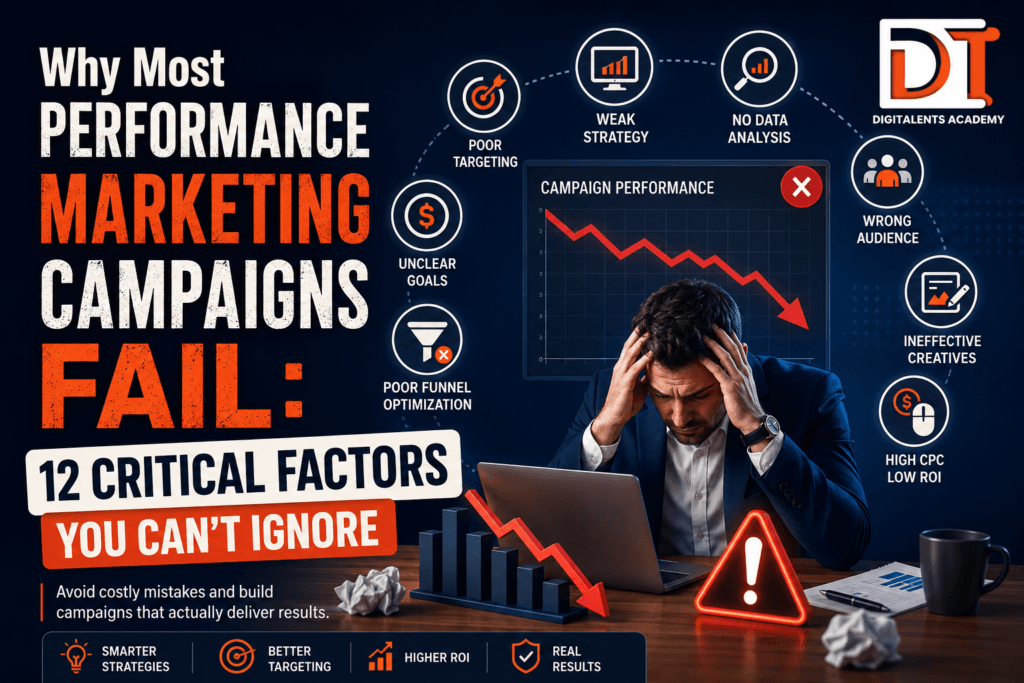
Performance marketing has completely changed the way businesses advertise online. Unlike traditional marketing, where companies pay for exposure regardless of the outcome, performance marketing focuses on measurable results such as clicks, leads, sales, app installs, or conversions.
However, despite investing significant budgets into platforms like Google Ads, Meta Ads, LinkedIn Ads, and YouTube Ads, many businesses struggle to achieve profitable results. Studies across the digital marketing industry consistently show that a large percentage of campaigns underperform due to poor planning, weak execution, and a lack of optimization.
So, why do most performance marketing campaigns fail?
The answer isn’t usually the advertising platform itself. Instead, it’s often a combination of strategic mistakes, technical issues, and missed opportunities that reduce campaign effectiveness.
In this comprehensive guide, you’ll discover the 12 most critical factors that lead to performance marketing failure, practical solutions to overcome them, and how Digitalents Academy equips students and professionals with hands-on skills to run profitable campaigns.
What Is Performance Marketing Campaigns?
Performance marketing is a digital advertising model where businesses pay only when a predefined action occurs. These actions may include:
Website clicks
Lead form submissions
Product purchases
Phone calls
App downloads
Newsletter sign-ups
Popular performance marketing platforms include:
Google Ads
Meta Ads (Facebook & Instagram)
LinkedIn Ads
Microsoft Ads
YouTube Ads
TikTok Ads
The primary goal is to maximize Return on Investment (ROI) while minimizing advertising costs.
Why Performance Marketing Campaigns Matters
Modern businesses demand measurable outcomes. Performance marketing enables organizations to:
Increase qualified leads
Improve sales conversions
Reach highly targeted audiences
Track every marketing rupee spent
Scale campaigns based on performance
Make data-driven decisions
When managed correctly, performance marketing campaigns becomes one of the most profitable digital marketing channels available.
Setting Unrealistic Campaign Goals
One of the biggest reasons campaigns fail is the absence of realistic objectives.
Many advertisers expect immediate sales without first building awareness or trust.
Instead, campaigns should have SMART goals:
Specific
Measurable
Achievable
Relevant
Time-bound
Examples include:
Generate 100 qualified leads in 30 days.
Achieve a cost per lead below ₹300.
Increase website conversions by 25%.
Clear goals guide every optimization decision.
Poor Audience Targeting
Even an excellent advertisement will fail if it’s shown to the wrong audience.
Common targeting mistakes include:
Targeting everyone
Ignoring demographics
No audience segmentation
Not using remarketing
Missing lookalike audiences
Successful marketers create audience segments based on:
Age
Gender
Location
Interests
Purchase behavior
Website activity
Precise targeting significantly improves campaign performance.
Weak Keyword Research
For Google Ads campaigns, keyword selection is critical.
Many businesses:
Choose only broad keywords
Ignore long-tail keywords
Forget negative keywords
Focus only on high-volume searches
Instead, use a balanced mix of:
Exact match keywords
Phrase match keywords
Long-tail keywords
Commercial intent keywords
Brand keywords
Keyword optimization helps attract users who are genuinely interested in your products or services.
Poor Ad Copy That Doesn’t Convert
Many ads receive impressions but very few clicks because they fail to capture attention.
High-converting ads typically include:
Strong headlines
Emotional triggers
Clear benefits
Social proof
Powerful calls-to-action
Instead of writing:
“Learn Digital Marketing.”
Write:
“Become Job-Ready with Practical Digital Marketing Training and Live Projects.”
The second version clearly communicates value.
Ignoring Landing Page Optimization
Driving traffic is only half the battle.
If visitors land on a confusing or slow website, they leave without converting.
A high-performing landing page should have:
Fast loading speed
Mobile responsiveness
Clear headline
Trust signals
Student testimonials
Simple forms
Strong CTA buttons
Every click should lead users toward one clear action.
Not Tracking Conversions Correctly
Without setting up conversion tracking, we should not be running ads.
Essential tracking tools include:
Google Analytics 4 (GA4)
Google Tag Manager
Google Ads Conversion Tracking
Meta Pixel
Enhanced Conversions
Without accurate tracking, advertisers cannot determine which campaigns are generating real business results.
Poor Budget Allocation
Some advertisers spend too much too quickly, while others allocate budgets that are too small to gather meaningful data.
A successful budget strategy includes:
Daily budget planning
Campaign prioritization
Bid adjustments
ROI analysis
Regular optimization
Avoid increasing budgets dramatically without sufficient performance data.
Ignoring Campaign Optimization
Launching a campaign is just the beginning.
Successful advertisers continuously monitor:
Click-through rate (CTR)
Conversion rate
Cost per click (CPC)
Cost per acquisition (CPA)
Return on ad spend (ROAS)
Optimization should include:
A/B testing
Bid adjustments
Audience refinement
Keyword expansion
Ad copy improvements
Regular optimization prevents wasted ad spend.
Poor Mobile Experience
More than half of digital traffic now comes from mobile devices.
Common mobile issues include:
Slow page speed
Small fonts
Difficult navigation
Long forms
Broken buttons
A seamless mobile experience can dramatically improve conversion rates.
Ignoring Data and Analytics
Successful marketers rely on data rather than assumptions.
Key performance metrics include the following:
Impressions
Reach
Clicks
CTR
CPC
CPA
ROAS
Conversion Rate
Bounce Rate
Analyzing these metrics helps identify strengths, weaknesses, and opportunities for improvement.
Not Testing Different Ad Variations
Running a single advertisement limits your potential.
Instead, test multiple versions of:
Headlines
Images
Videos
CTAs
Landing pages
Audience segments
Even small improvements can significantly increase overall campaign performance.
Lack of Practical Knowledge and Training
Many businesses fail simply because they lack experienced marketers who understand modern advertising platforms.
Digital marketing changes rapidly, with frequent updates to:
Google Ads
Meta Ads Manager
Google Analytics 4
AI-powered bidding
Audience targeting
Privacy regulations
Continuous learning is essential for staying competitive.
How Digitalents Academy Helps You Master Performance Marketing Campaigns
Knowing the theory is not enough. Success in performance marketing comes from practical experience, strategic thinking, and continuous optimization. Digitalents Academy focuses on preparing students for real-world digital marketing careers through hands-on learning.
Industry-Oriented Curriculum
The curriculum is designed to match current industry requirements and includes:
Google Ads
Meta Ads
Search Engine Optimization (SEO)
Google Analytics 4
Google Tag Manager
Email Marketing
Content Marketing
Social Media Marketing
AI Tools for Digital Marketing
WordPress Website Development
Live Campaign Experience
Students work on practical projects where they learn to:
Create campaigns from scratch
Conduct keyword research
Build landing pages
Set up conversion tracking
Optimize campaignsAnalyzeperformance reports
This practical exposure helps build confidence before entering the workforce.
Experienced Trainers
Digitalents Academy emphasizes learning from professionals with industry experience. Students receive guidance on campaign planning, optimization techniques, and current best practices used by businesses.
Placement Assistance
The academy also provides career support through:
Resume preparation
Mock interviews
Portfolio development
Interview guidance
Job placement assistance
This helps students transition from learning to employment more effectively.
Why Choose Digitalents Academy?
Some of the key benefits include:
Practical training with live projects
Exposure to the latest digital marketing tools
AI-integrated learning
Industry-relevant curriculum
Placement support
Affordable course fees
Suitable for beginners, professionals, business owners, and freelancers
Whether you are starting a career, looking to upskill, or planning to grow your business through digital advertising, Digitalents Academy aims to provide the practical skills needed for today’s marketing landscape.
Best Practices for Running Successful Performance Marketing Campaigns
To improve campaign outcomes, keep these principles in mind:
Define measurable objectives before launching.
Research your audience thoroughly.
Use commercial-intent keywords.
Write compelling ad copy with clear calls to action.
Build fast, focused landing pages.
Implement accurate conversion tracking.
Monitor campaigns daily.
Test different creatives and audiences.
Review analytics regularly.
Keep learning as advertising platforms evolve.
Frequently Asked Questions (FAQs)
Why do performance marketing campaigns fail?
Most campaigns fail because of poor targeting, weak ad creatives, ineffective landing pages, inadequate conversion tracking, unrealistic expectations, and insufficient optimization.
Which platform is best for performance marketing?
The right platform depends on your goals. Google Ads is often ideal for high-intent searches, while Meta Ads can be effective for awareness and audience targeting. Many businesses benefit from using both together.
How important is conversion tracking?
Conversion tracking is essential. Without it, you cannot accurately measure which ads, keywords, or audiences are generating valuable business results.
Is performance marketing a good career?
Yes. Demand for professionals skilled in Google Ads, Meta Ads, analytics, and campaign optimization continues to grow across industries.
Can beginners learn performance marketing?
Absolutely. With structured training, hands-on practice, and guidance from experienced instructors, beginners can build the skills needed to run successful campaigns.
Conclusion
Performance marketing campaigns offers tremendous opportunities for businesses to generate measurable growth, but success requires more than simply launching advertisements. Campaigns often fail because of avoidable mistakes such as poor audience targeting, weak keyword research, ineffective landing pages, missing conversion tracking, and a lack of ongoing optimization.
By understanding these 12 critical factors, marketers can improve campaign performance, reduce wasted ad spend, and achieve stronger returns on investment.